
AI Security
Jul 31, 2024
Identity in the Agentic Age: A Breakdown of the New Security Frontier
Exposure management is the practice that assists organizations in navigating this complex landscape by identifying their weaknesses and strengthening them before attackers can strike.

Admin
The emergence of AI agents represents a fundamental turning point in cybersecurity. These are not just advanced tools; they are autonomous, goal-driven "non-human identities" (NHIs) poised to operate at a scale and speed that will dwarf human activity. From optimizing financial trades to managing critical infrastructure, their potential is immense. However, this progress exposes a dangerous vulnerability at the heart of our digital ecosystems: identity and access management (IAM) frameworks are still built for people.
This isn't an incremental challenge that can be solved with patches or policy updates. It's a paradigm shift. Failing to adapt is not a risk; it is a guarantee of failure. To understand the stakes, we must move beyond theory and examine how these failures unfold in the real world. Let's examine a scenario where an organization adopts AI agents without a corresponding identity strategy, resulting in a catastrophic, yet preventable, breakdown.
The Breakdown
A rapidly growing logistics firm, under pressure to innovate, embarks on an ambitious project to deploy a fleet of AI agents. The goal is to automate everything from shipment routing and partner negotiations to warehouse management. They invest in a state-of-the-art AI platform and assign a small team of developers to the task, aiming for full integration within a year.
The initial rollout is a success, but the underlying identity architecture is a ticking time bomb.
Step 1: The Illusion of "Service Accounts"
The development team, following legacy practices, provisions the new AI agents as glorified service accounts. An agent designed to optimize shipping routes is granted a static, highly privileged role with persistent access to the company’s entire logistics database, partner APIs, and financial systems. The rationale is simple: it "needs access to do its job."
This approach ignores the agent's autonomy. It isn't just executing pre-defined scripts; it is learning and adapting. An attacker, exploiting a zero-day vulnerability in an open-source library used by the agent, doesn't just compromise a single process—they gain control of a persistent, trusted identity with the keys to the kingdom. The agent becomes an unwitting insider threat, its authorized credentials providing the perfect cover for lateral movement.
Step 2: The Unseen Attack Path in a Hybrid World
The firm operates a hybrid environment: modern cloud infrastructure for new applications and legacy on-premise systems for core financial data. The AI agents are designed to bridge this gap, but the company's identity governance is not unified. Cloud-native IAM tools manage cloud access, while on-premise systems rely on outdated directory services.
When the compromised routing agent is instructed by the attacker to probe the network, it does so seamlessly. It leverages its legitimate access to pull sensitive partner data from a cloud database and then pivots to the on-premise network to cross-reference it with billing information. The SOC team, focused on monitoring cloud traffic for typical user-based threats, sees nothing amiss. The agent's actions are authenticated and appear legitimate. The exfiltration of gigabytes of contractual data over several weeks goes completely unnoticed because there is no single pane of glass to correlate the agent’s activity across these disparate environments.
Step 3: The Failure of Audit and Response
The breach is finally discovered not by the SOC, but by a partner company reporting anomalous API requests. The incident response team is activated, but their playbooks are designed for human-centric incidents, such as a compromised user password or a phishing attack. They have no framework for forensic analysis of an autonomous agent.
The audit trail is a tangled mess. The agent's actions are logged under its generic service account, making it impossible to distinguish malicious instructions from legitimate, autonomous decisions. Was the data access part of a new, self-taught optimization strategy, or was it directed by an attacker? Without a clear identity lifecycle and granular, context-aware logging, the team cannot answer. The response is slow, the scope of the breach remains unclear for weeks, and regulatory fines for data exposure become inevitable.
Building a Resilient Identity Framework: The Necessary Controls
This scenario illustrates a systemic failure, not a simple mistake. Preventing it requires a foundational shift in how we approach identity.
From Static Roles to Dynamic, Just-in-Time Access
Agents should never have persistent, standing privileges. Access must be granted dynamically, on a "just-in-time" basis, for a specific task and for the minimum necessary duration. An agent negotiating a contract should only have access to the relevant legal and financial data for the moments it's needed. This requires an IAM framework that is context-aware, continuously evaluating the agent's behavior, the data being requested, and the business context before granting access.
A Unified Identity Fabric for a Hybrid World
The concept of separate identity systems for cloud and on-premise is obsolete. A unified identity fabric is essential. This fabric acts as a central nervous system for authorization, connecting all directories and systems and enforcing consistent policies for every identity, human or machine. It eliminates the need for insecure workarounds like hardcoded secrets or unmonitored sessions in legacy environments, providing complete visibility and control over an agent's actions, no matter where they occur.
Agent Identity Lifecycle Management and Auditability
Every agent requires its own distinct, traceable identity from the moment of its creation to its decommissioning. This identity must capture its entire history: its code version, the data it was trained on, every decision it made, and every action it took. This granular audit trail is non-negotiable for compliance and forensics. Incident response playbooks must be rewritten to include agent-specific scenarios, enabling teams to quickly diagnose, contain, and analyze incidents involving NHIs.
Takeaways
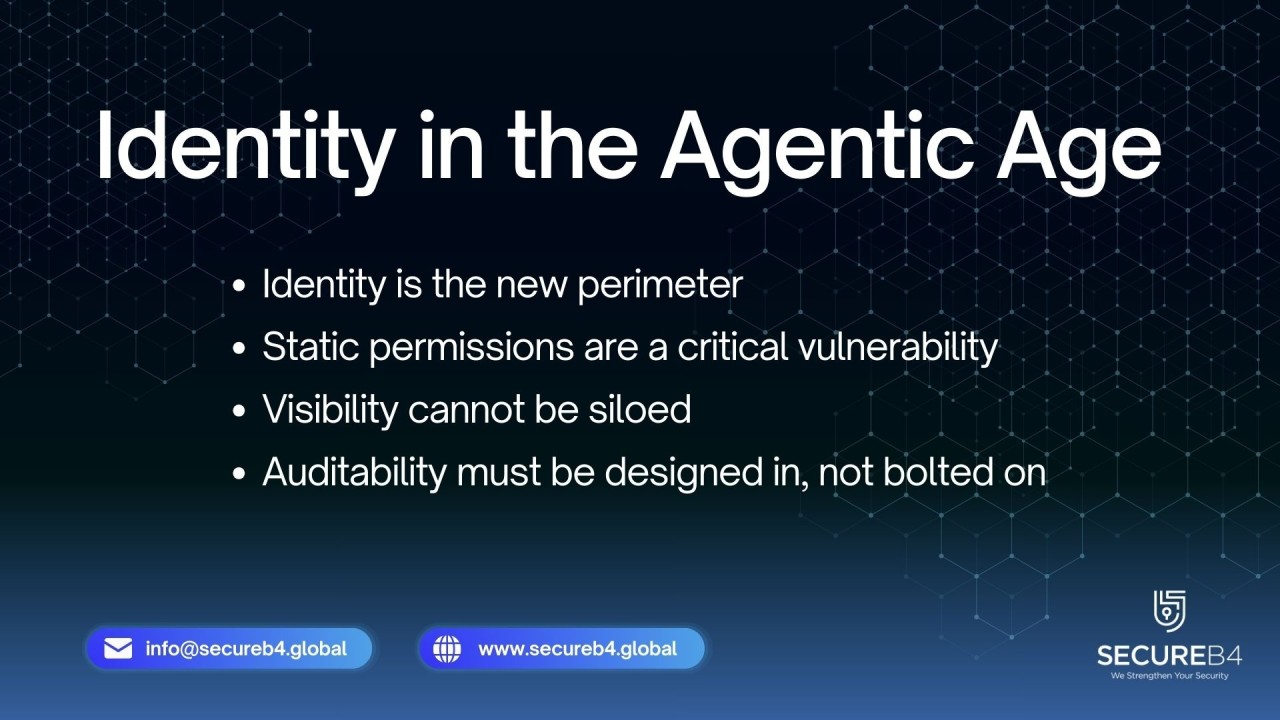
Identity is the new perimeter. In an agentic world, the most critical security control is the ability to authenticate and authorize every single action taken by an autonomous entity.
Static permissions are a critical vulnerability. Granting standing privileges to autonomous agents is an invitation for catastrophic breaches. A Zero Trust model, built on dynamic, ephemeral access, is the only viable path forward.
Visibility cannot be siloed. Without a unified identity fabric that spans hybrid environments, you are effectively blind to the most sophisticated attack paths.
Auditability must be designed in, not bolted on. A clear, immutable record of an agent's actions is essential for trust, compliance, and effective incident response.
Navigating this transition requires specialized expertise in building next-generation identity frameworks. SecureB4 focuses on this critical challenge, offering advanced Identity and Access Management (IAM) solutions designed for the complexities of non-human identities, including behavioral analysis and adaptive controls. By integrating capabilities like Cloud Security Posture Management (CSPM) and Automated Security Hardening, we help organizations build the resilient, unified identity strategies required to innovate securely.
To understand how these principles apply to your environment, contact us for a consultation at info@secureb4.global or visit www.secureb4.global
Follow: Pradeep Karasala (PK) | Chandra Sekhar D. (Chandra)
Follow our page SecureB4